Business Rules & Constraints
Chapter 2 — Encode the Limits
Real decisions live inside rules: minimum commitments, contractual caps, channel saturation, policy floors. Prescriptive analytics encodes these as explicit constraints so the recommendation is not just profitable but allowed. A plan that maximizes return by pouring the entire budget into one channel is worthless if a contract caps that channel at $50K.
The Rules for This Decision
- Total budget: spend at most $100K.
- West: between $10K (minimum commitment) and $60K.
- Email: up to $40K (audience saturates beyond that).
- Paid search: between $5K and $50K (contracted ceiling).
Python · constraints as data
# Each channel gets a (min, max) feasible range
bounds = [(10_000, 60_000),   # West
          (0,      40_000),   # Email
          (5_000,  50_000)]   # Paid search
budget = 100_000              # sum(spend) <= budget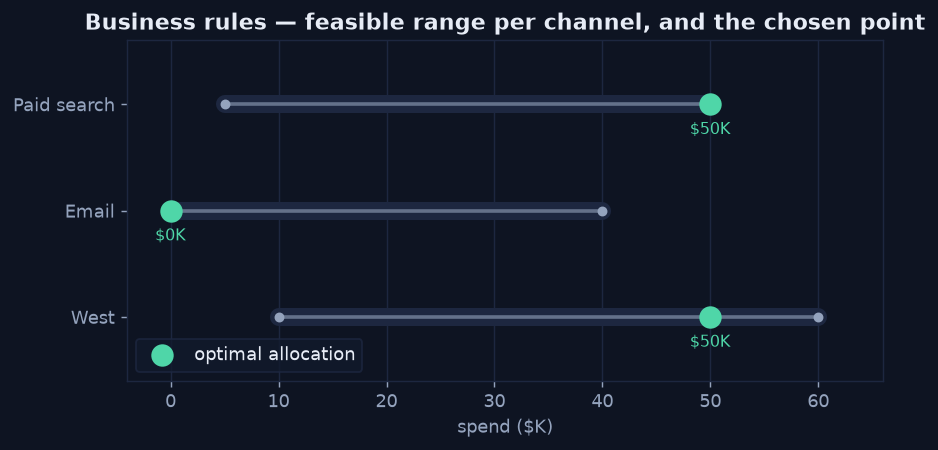
Each channel's feasible range (the bar) and the chosen allocation (the point) — every recommendation must land inside these limits.
Rules Without Optimization
Not every decision needs a solver. Many prescriptive recommendations are simple, deterministic
rules — and SQL expresses them directly. A CASE statement encodes the policy and
produces a recommended action per row, no model required.
SQL
SELECT
  region,
  AVG(profit / sales) AS avg_margin,
  CASE
    WHEN AVG(profit / sales) < 0.10 THEN 'Cut discounts'
    WHEN AVG(discount)       > 0.20 THEN 'Review pricing'
    ELSE                                 'Hold'
  END AS recommended_action
FROM orders
GROUP BY region;
Why Constraints Come First
Defining the feasible region before optimizing is what separates a usable recommendation from a fantasy. The constraints shrink the space of possible plans down to the ones the business can actually execute — and only then does it make sense to search that space for the best one. That search is the next chapter.